BIGGLES OF THE CAMEL SQUADRON
Book First Published in March 1934 - 254 pages
Re-published in 1993 as Biggles of the Fighter Squadron
Five of the stories were originally published in five issues of Popular Flying Magazine, from January
1933 until May 1933
These stories were later all published in thirteen parts, with
individual story titles, in The Modern Boy, issues
284 to 296, dated 15th July 1933 to 7th October 1933
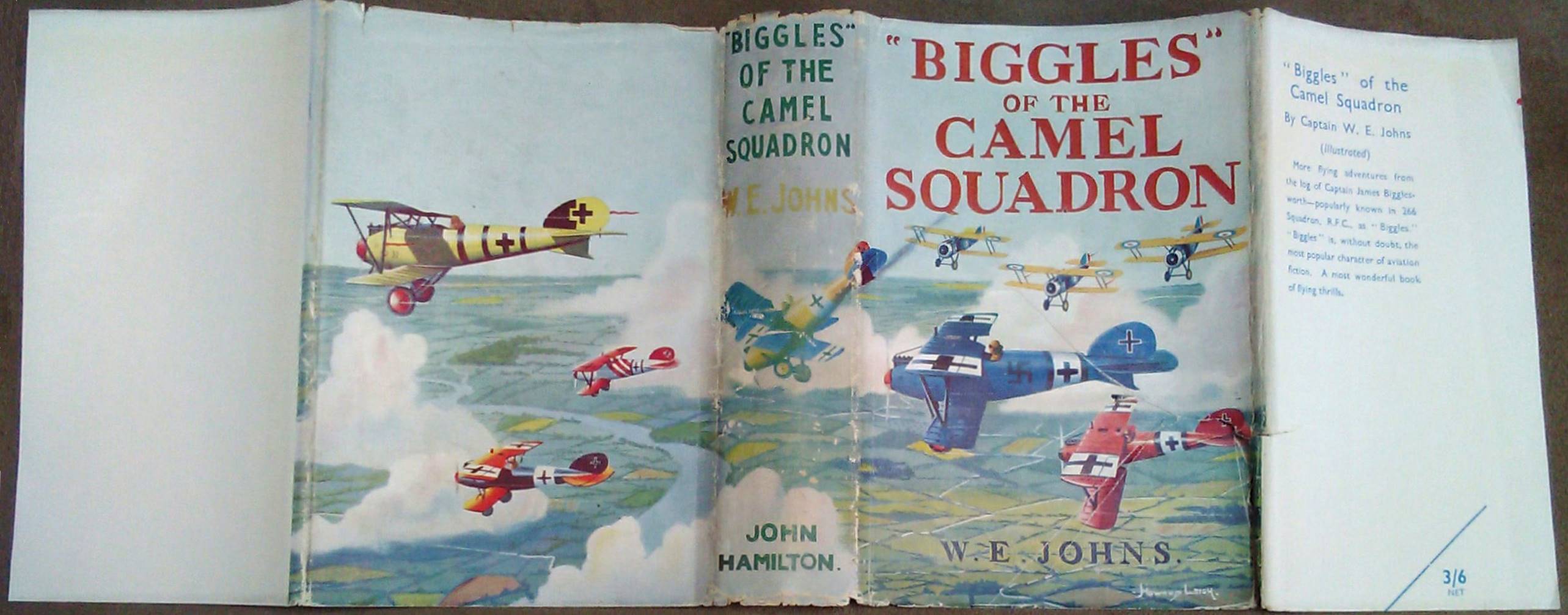
This is an original dust wrapper but I
don’t know which edition of the book it is from. I know the first edition was priced 3/6.
FIND OUT ALL ABOUT
THE MUCH SOUGHT AFTER FIRST EDITION AND HOW TO IDENTIFY IT - BY CLICKING HERE
This contains thirteen short stories. The stories are:-
FORWARD (a
short essay by W. E. Johns)
HOW BIGGLES WAS "BORN" (a short essay by W. E. Johns)
(NB How Biggles was "born" is not in the original Hamilton
edition but only in the subsequent reprints)
THE PROFESSOR (pages 15 to 34)
A new squadron
member joins Biggles' Squadron. He is Henry Watkins and he believes that the
laws of mathematics have a solution for most aerial problems. He first
discusses 'deflection' shooting, that is, shooting in front of a moving object
at the place where the missile and object should collide. Henry goes with
Biggles and Algy on a raid on Aerodrome 32 and soon gets completely lost in the
comprehensive low cloud cover. Biggles and Algy carry out the raid alone and
cause two Albatrosses to collide whilst trying to take off. Algy finished off
another Albatross that managed to take off. Henry, meanwhile, has a
confrontation with a German Hannoverana plane and manages to shoot it down,
more by luck than judgement. Coming down through the cloud and finding himself over
an aerodrome, Henry bombs it and then managed to get back to his own airfield.
The later arrival of Major Sharp from 287 Squadron, wanting to know which fool
has bombed his aerodrome has embarrassing consequences for Henry.
(This story was originally first published in the January 1933
edition of Popular Flying Magazine – click here for more details)
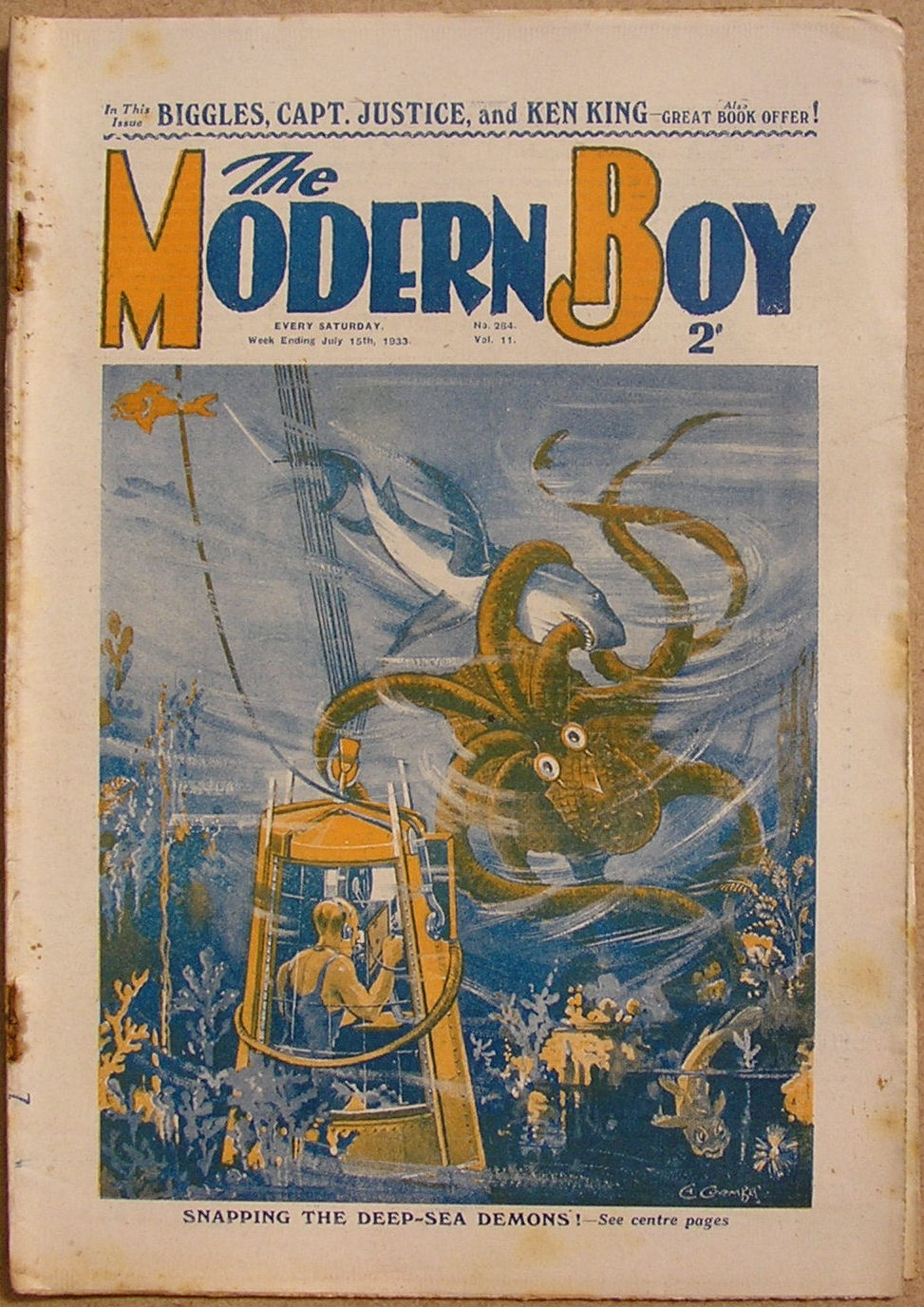
This story was later republished as "The Flying
Professor!" in issue number 284 of "The Modern Boy" dated 15th July
1933
THE JOY RIDE (pages 35 to 46)
Click here to see story illustration

Biggles
decides to go for a ride in a captured German Albatross and finds himself in
trouble. He is shot at by British troops and ends up flying in formation with
some other German planes. He feels completely unable to fire on the Germans
from a German marked plane, because such an act would have horrendous
consequences. If the Germans flew in captured British planes, soon everybody
would be shooting their friends down. One German is suspicious of Biggles and
won't let him lag behind and slip away. Suddenly they are attacked by British
S.E.5's and it is Biggles' own good friend Wilks who gets on Biggles' tail.
Biggles puts his hands up to surrender and crash lands in a field. Wilks lands
too and is astonished to see the identity of the German he has caught.
(This story was originally first published in the February 1933
edition of Popular Flying Magazine – click here for more details)
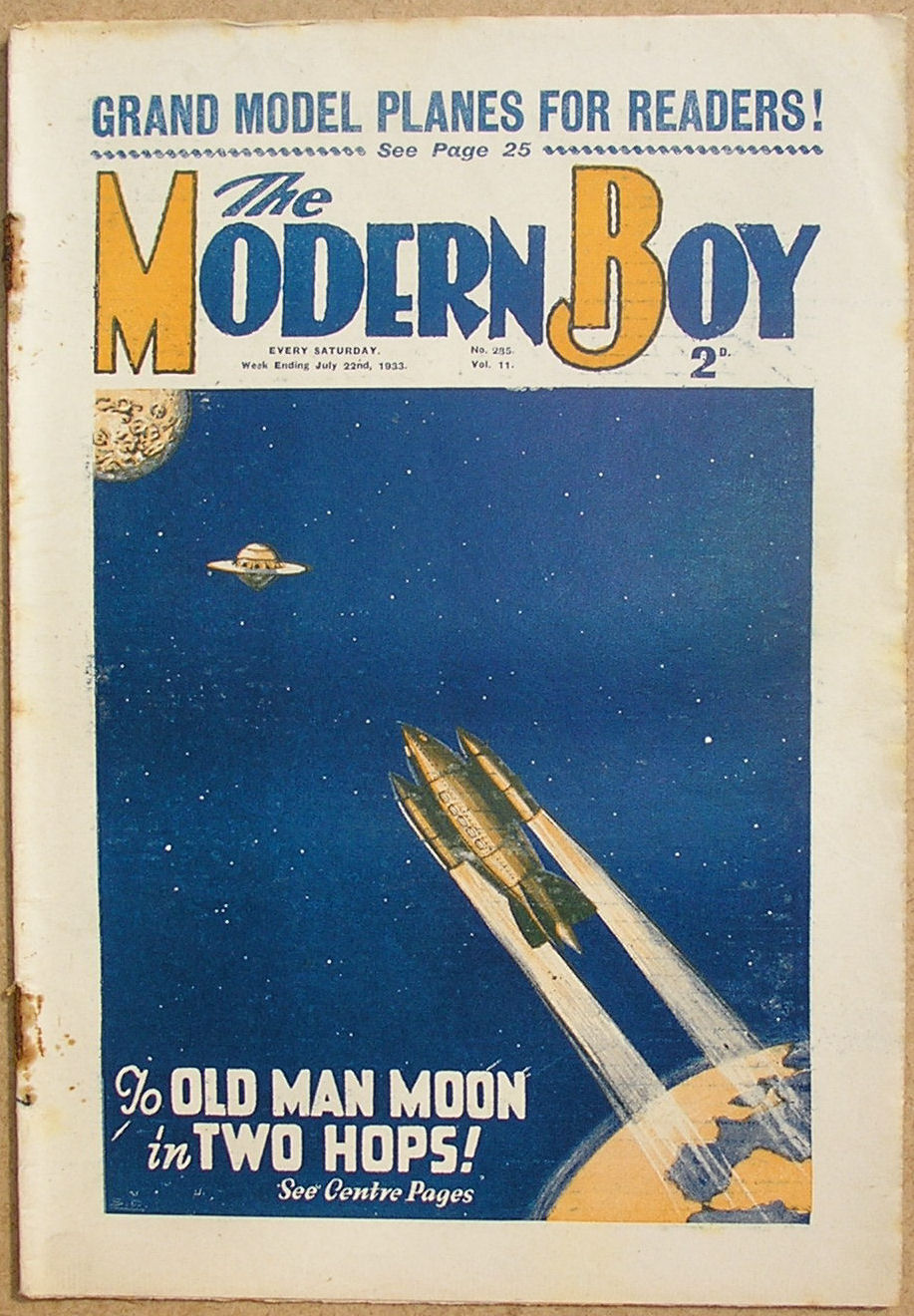
This story was later republished as "Biggles Joy-Ride!" in
issue number 285 of "The Modern Boy" dated 22nd July
1933
THE BRIDGE PARTY (pages 47 to 62)
Henry
Watkins, nicknamed 'the Professor', is determined to blow up a German held
bridge and has a good idea how to do it. Instead of dropping bombs from above,
he intends to fly underneath and drop one below it. Unfortunately, the arch is
not wide enough to accommodate his aircraft and wingspan and he comes out the
other side minus his wings. Henry is then faced with the difficult task of
getting to the front line and crossing the lines without being killed - no mean
feat.
(This story was originally first published in the March 1933
edition of Popular Flying Magazine – click here for more details)
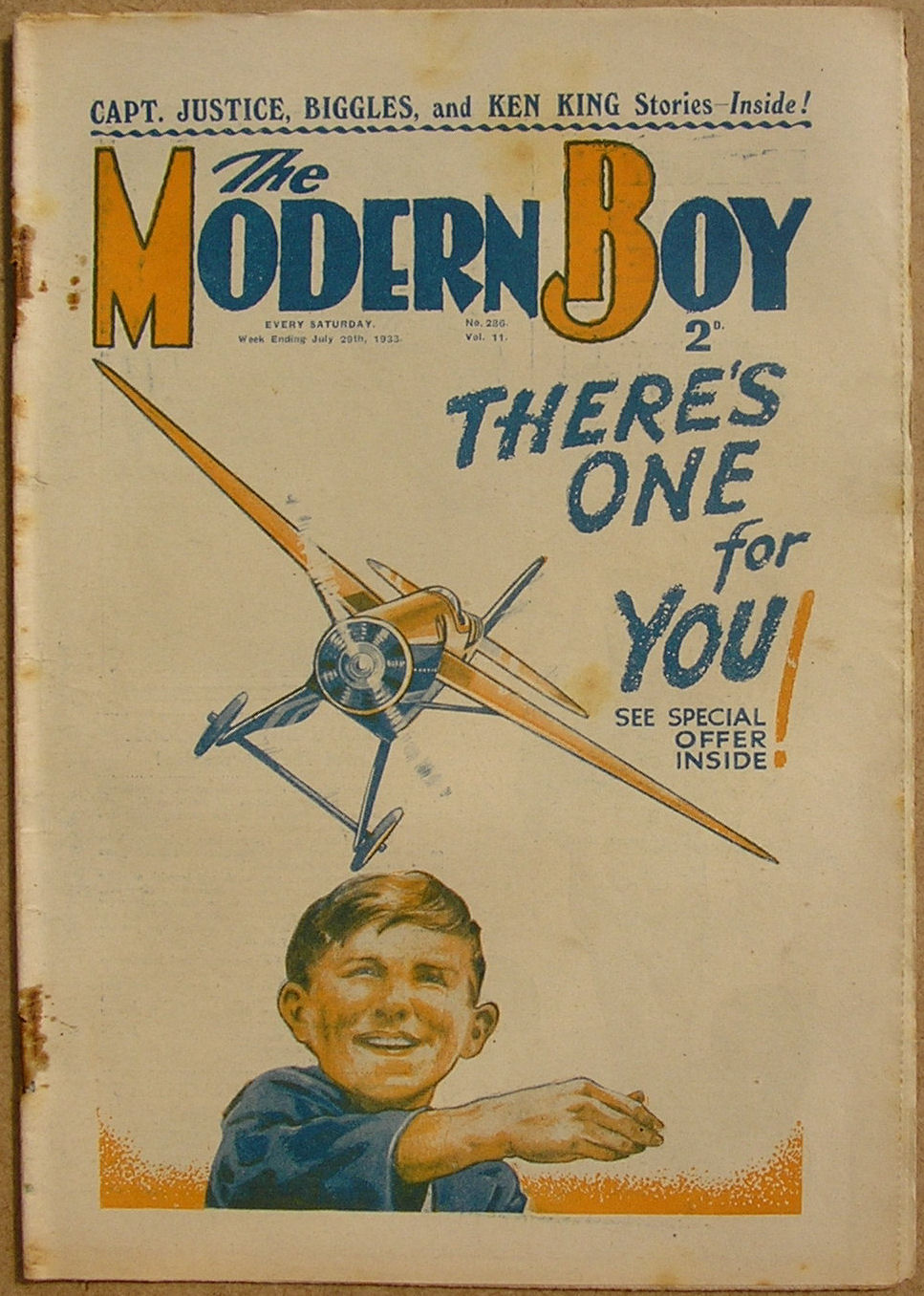
This story was later republished as "The Bridge They Couldn’t
Blow Up!" in issue number 286 of "The Modern Boy" dated 29th July
1933
THE BOTTLE PARTY (pages 63 to 77)
Henry
Watkins has an idea as to how to shoot down the three new balloons at
Duneville. He suggests dropping bottles in order to get the surrounding gun
crews to hide in their dug outs as a falling bottle makes a hell of a racket
when it falls. The plan is to use nine aeroplanes, six machines will drop nine
bottles each and then fly away to draw off the protecting German Fokkers. The
remaining three, Biggles, Algy and Henry, will then each attack a balloon,
while there is no 'archie' due to the bottles frightening the gun crews.
Biggles and Algy hit their balloons first time but Henry misses and goes back
to finish it off. By this time, the gun crews are back in action and all hell
breaks loose. Our heroes then have to shoot it out with the returning Fokkers.
Two Fokkers collide. Henry fails to return and later an observation post
reports seeing a Sopworth Camel having fallen in flames. Henry has gone.
(This story was originally first published in the April 1933
edition of Popular Flying Magazine – click here for more details)
This story was later republished as "The Bottle Bombers!"
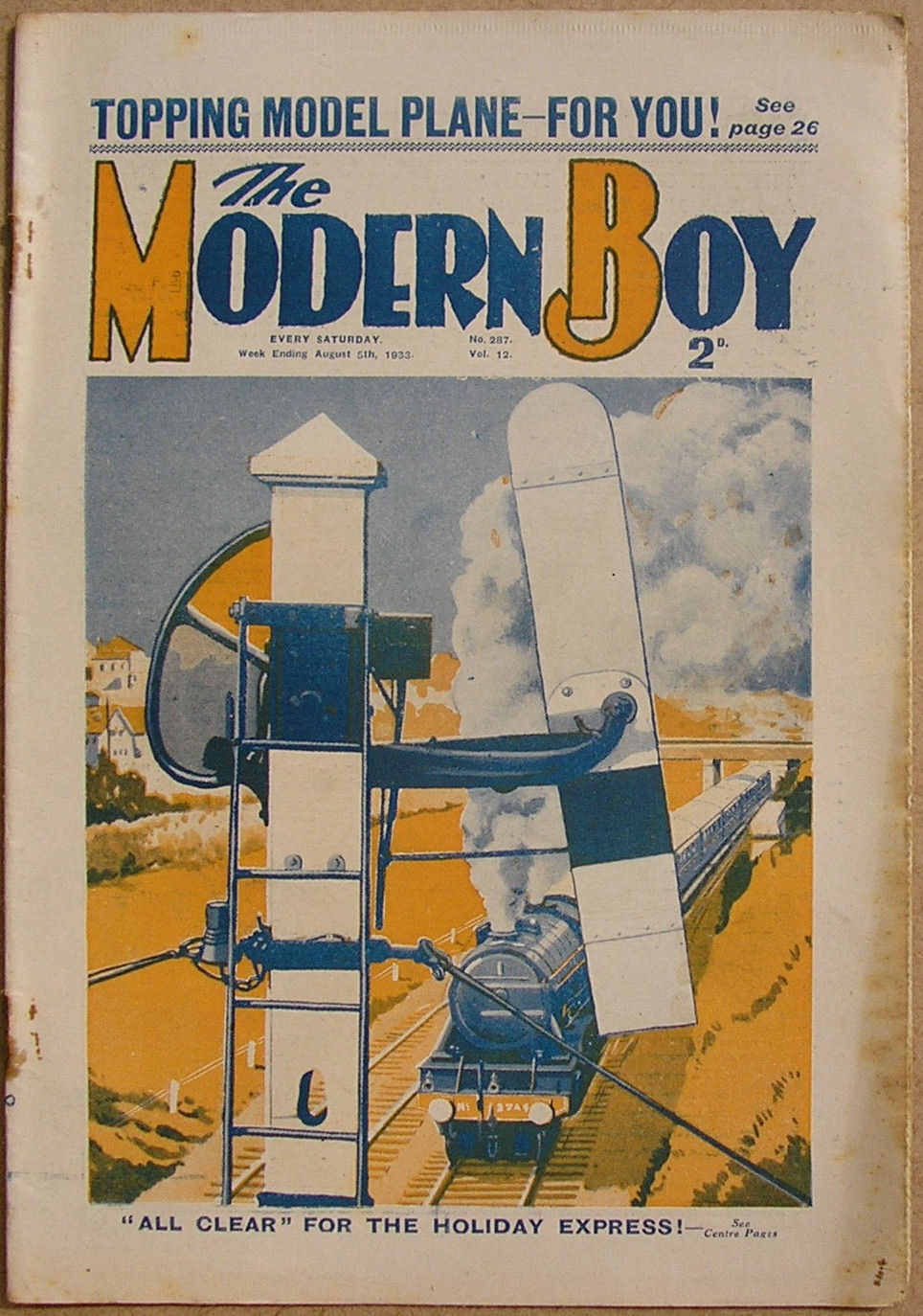
in issue number 287 of "The Modern Boy" dated 5th
August 1933
THE TRAP (pages 78 to 96)
The Germans
have set up a balloon with two dummies in it as a deadly trap, packed with high
explosive. Biggles sees it and is suspicious of the lack of movement of the
observers and flies back to his Squadron to warn everybody. He then telephones
Wilks at 287 Squadron to warn them only to find out that young Tom Ellis has
recently set off to have a go at it. Racing off to try and stop him, Biggles is
too late. Biggles sees Tom fly near the balloon when the Germans detonate it
and Tom is blown to bits. Returning in a rage, Biggles, close to cracking, goes
on a mad attack over German lines shooting up everything and everyone he can.
The following morning he has an idea for vengeance and the watching Germans, by
the balloon, see a Camel flying badly. During a particularly bad loop the pilot
of the Camel falls out and a large number of Germans gather to look at the
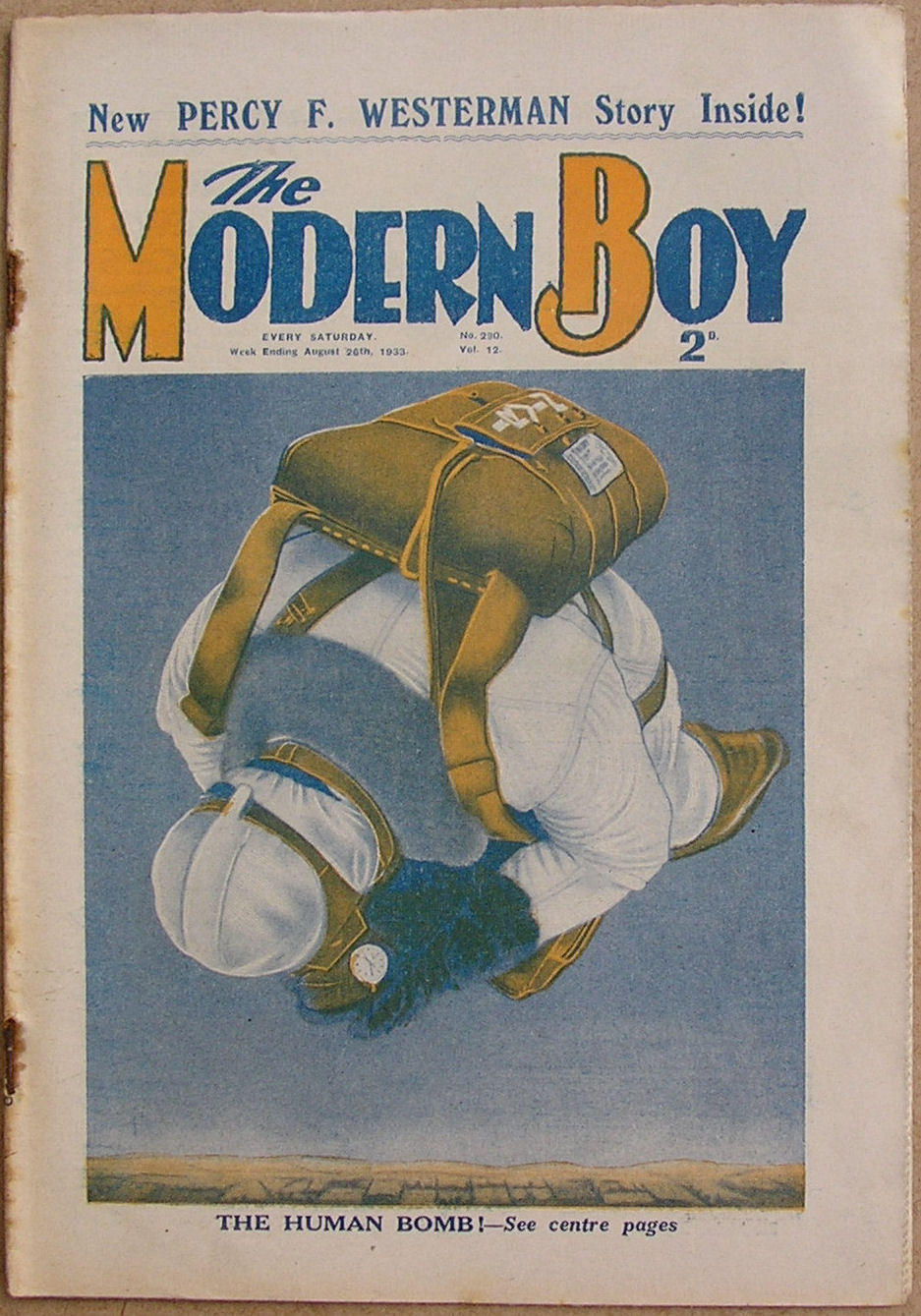
body. The "body" explodes killing them, as it was really 150 pounds
of high explosive wrapped in nails inside a flying-suit, cap, goggles, flying-boots
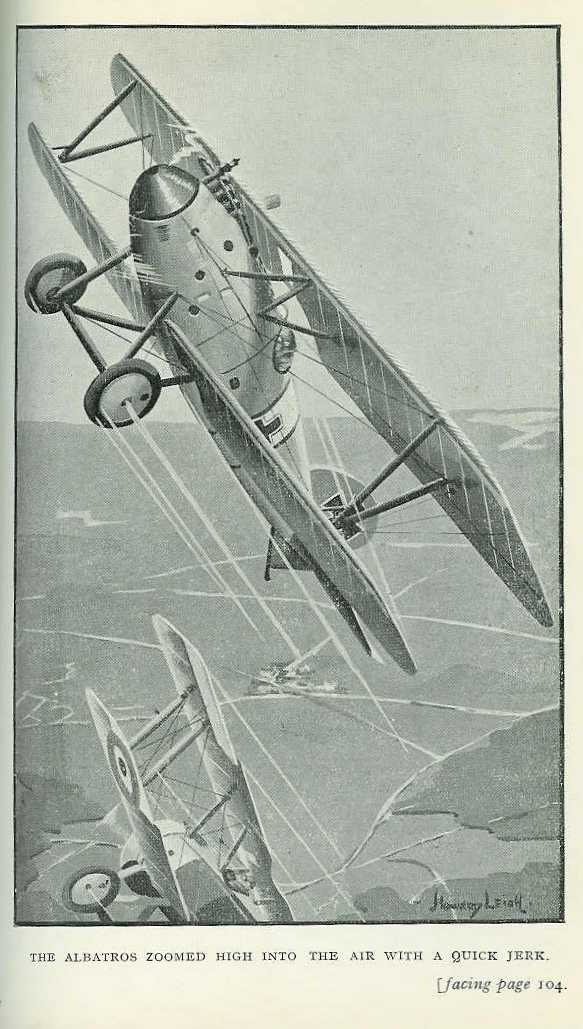
and gloves. The colour frontispiece for this book illustrates a scene from this
story.
(This story was originally first published in the May 1933 edition
of Popular Flying Magazine - click
here for more details)
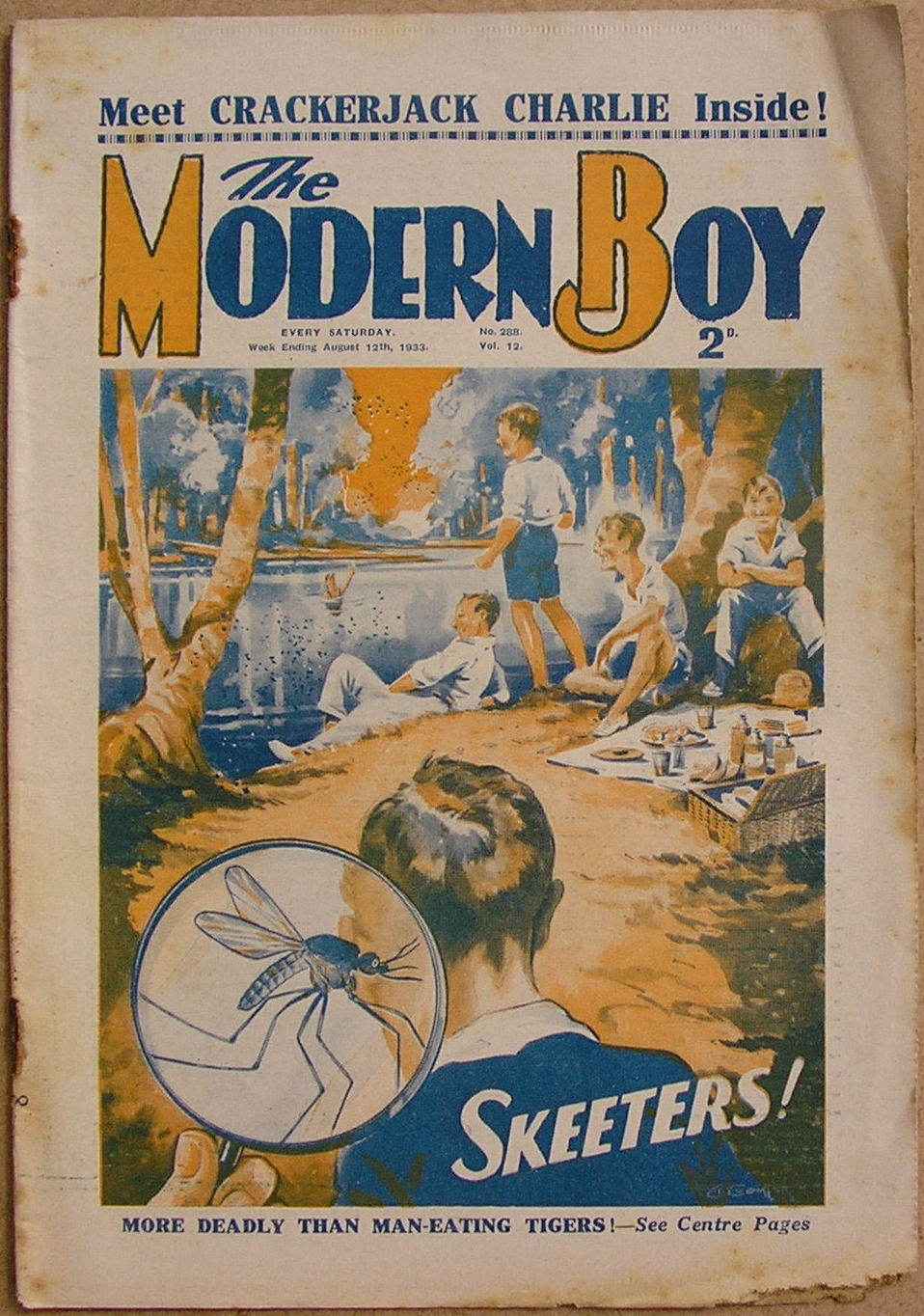
This story was later republished as "Biggles Plays Tit for
Tat!" in issue number 288 of "The Modern Boy" dated 12th
August 1933
THE FUNK (pages 97 to 114)
Click here to see story illustration
Biggles
has to train three new fliers (called Harcourt, Howell and Sylvester) posted to
his flight. Harcourt's immediate concern is how he is going to feed his
goldfish. The first thing Biggles does is to give them six hours' flying
practice a day, for three days, before he takes them over the lines. They are
soon in a dogfight and Harcourt flies away back to their aerodrome. Biggles
shoots down an Albatross but Sylvester is shot down as well. Returning to the
aerodrome, Biggles finds Harcourt and he admits that his nerve failed him.
Suddenly a Fokker D.VII flies over and drops a pair of boots over the aerodrome
- a sign that they should all join the infantry! Biggles flies off in a rage to
avenge the insult. Algy and, unexpectedly, Harcourt, fly off with him. Algy is
shot down in an ensuing dogfight with a number of German aircraft but Harcourt
fights like a demon and three Fokkers are destroyed by their own bad flying.
Back at base, Biggles discovers that the dropped boots had killed Harcourt's
goldfish and that was why he fought as he did.
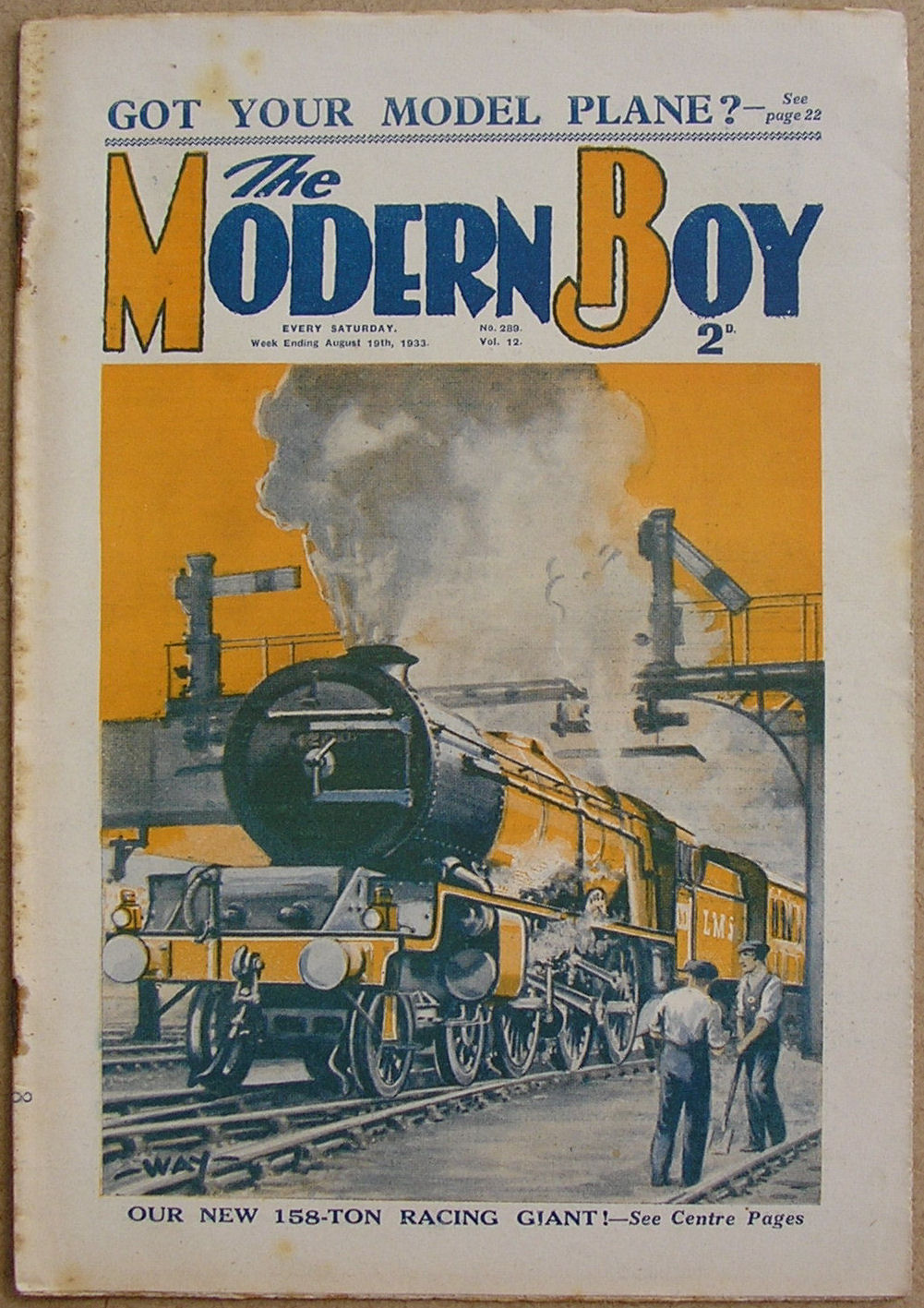
This story was later republished as "The Funk!" in issue
number 289 of "The Modern Boy" dated
19th
August 1933
THE PROFESSOR COMES BACK (pages 115 to 137)
Click here to see story illustration from the cover of 'Biggles - the Life of W.E. Johns'
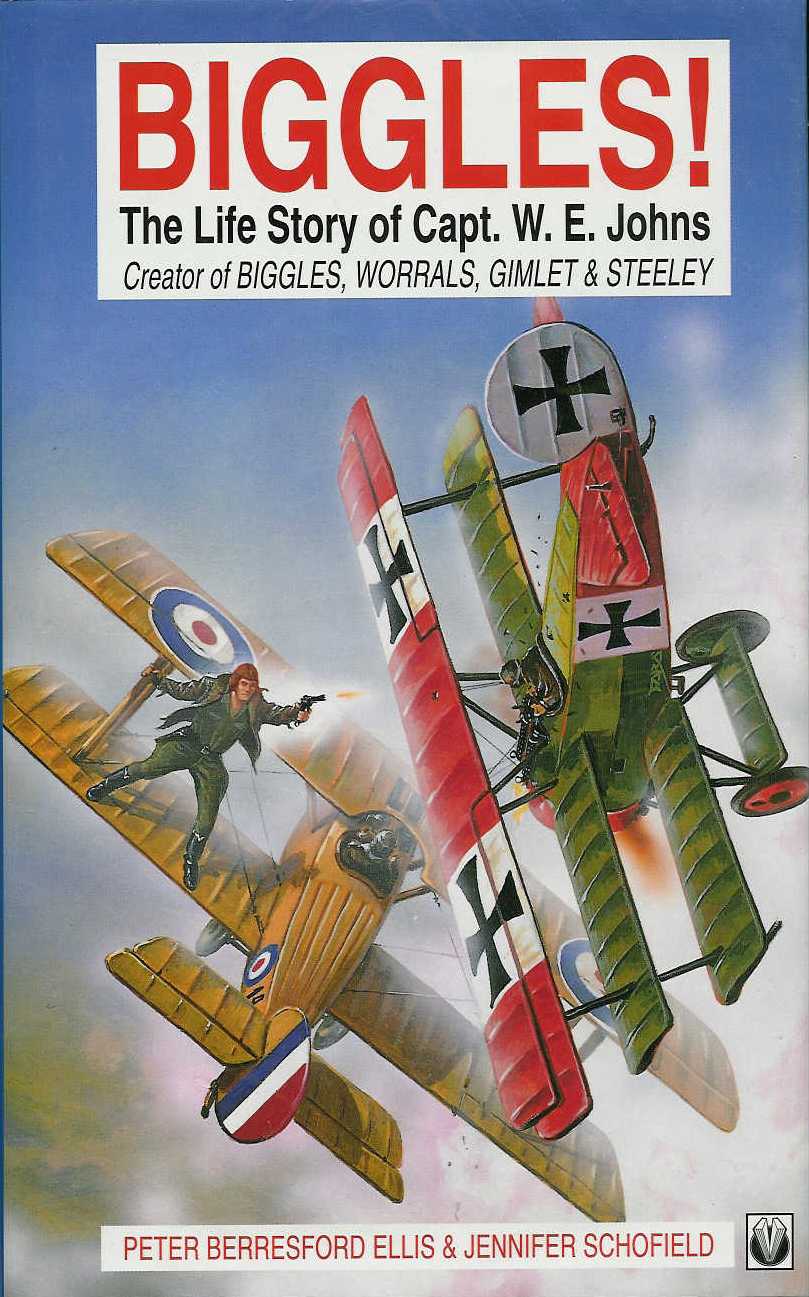
The
Germans report that Henry Watkins, who was previously shot down and believed
killed (see 'The Bottle Party' above), is a prisoner of war. Biggles recalls a
discussion with Henry that if he were ever to be captured he would escape and
go to a certain field behind enemy lines and light a signal fire. The Squadron
fly over the lines to the field and see a fire burning, so they then plan to
rescue Henry. That night however, the Squadron are bombed by German
Friedrichshafens. The hangers are hit and both 'A' flight and 'B' flight lose
their aircraft. The three planes of Biggles' 'C' flight survive and Biggles
flies over, with Algy and Harcourt, to rescue Henry. Biggles lands but is
shocked to discover that the area is a secret camouflaged base for the German
bombers! When Henry runs out in front of his plane, Biggles crashes. Algy and
Harcourt then land in an adjacent field to snatch both Biggles and Henry away
before the Germans can get them. Biggles holds onto the wing of Algy's Camel
and Henry holds onto the wing of Harcourt's Camel. They are then attacked by
Fokkers and Biggles stands up to shoot a very pistol at them. This is the
picture portrayed on the cover of the 1993 reprint of the Biggles
- The Life of Captain W.E. Johns which can be viewed by clicking the link above. They all get home
safely and arrange for the field holding the German Bomber Squadron to be
bombed to oblivion.
W.E. JOHNS MUST HAVE USED THIS STORY AS THE BASIS OF HIS 1939
BIGGLES BOOK “THE RESCUE FLIGHT”
AS IT IS CLEARLY BASED ON THE SAME IDEA.
This story was later republished as "The Wing-Riders!" in
issue number 290 of "The Modern Boy" dated 26th
August 1933
THE THOUGHT READER (pages 138 to 156)
Click here to see story illustration from the cover of the Thames reprint of this book
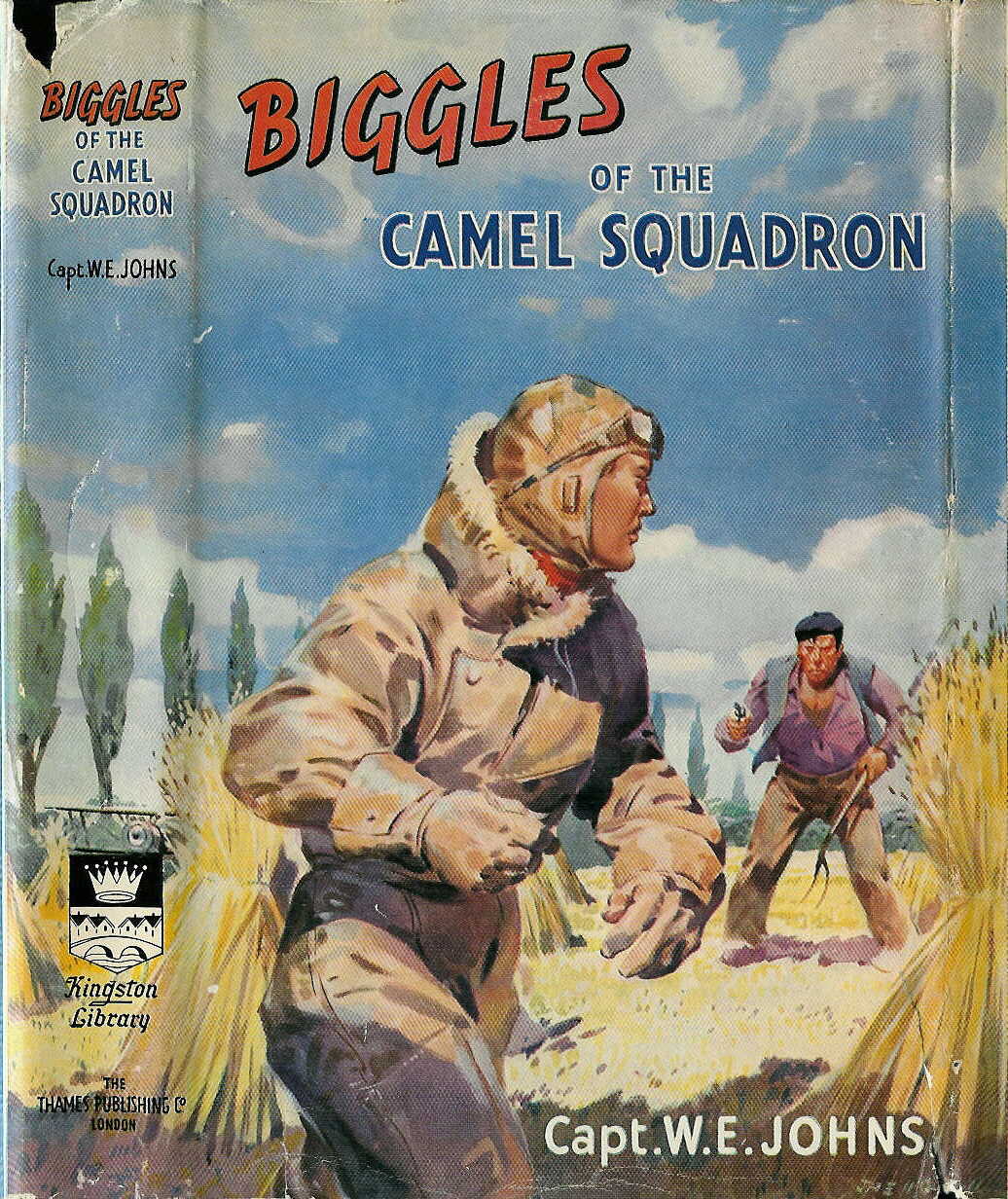
Biggles
is suspicious about the activities of a German plane that comes near his
aerodrome at the same time every day. He flies around to investigate and
realises that a French peasant is moving corn in a field in a way that sends
secret signals to the German plane. The corn is currently indicating the
whereabouts of an Army Brigade. Flying down and landing in an adjacent field,
Biggles plans to change the signal. However, the spy confronts him and shoots
him in the head. Remarkably, Biggles is just grazed by the bullet and recovers
consciousness soon after. He sees the spy has set fire to the French farmhouse
and is escaping in a car. Biggles runs back to his Camel and shoots the car up
causing it to crash. He then has to fly over to the Brigade and warn them to
move out before an artillery bombardment starts as the German spy plane would
have seen the signal. This he does, just in time. When the Thames Publishing
Company republished this book in the 1950's, this story was one of two that
were omitted from the reprint (the other story being 'Biggles Finds His Feet').
This was because the stories had already appeared in BIGGLES
PIONEER AIR FIGHTER. The cover of the Thames book shows Biggles being shot at by the
French peasant, a scene from this story that was not actually in that book! You
can see that cover by clicking on the link below the title of this story
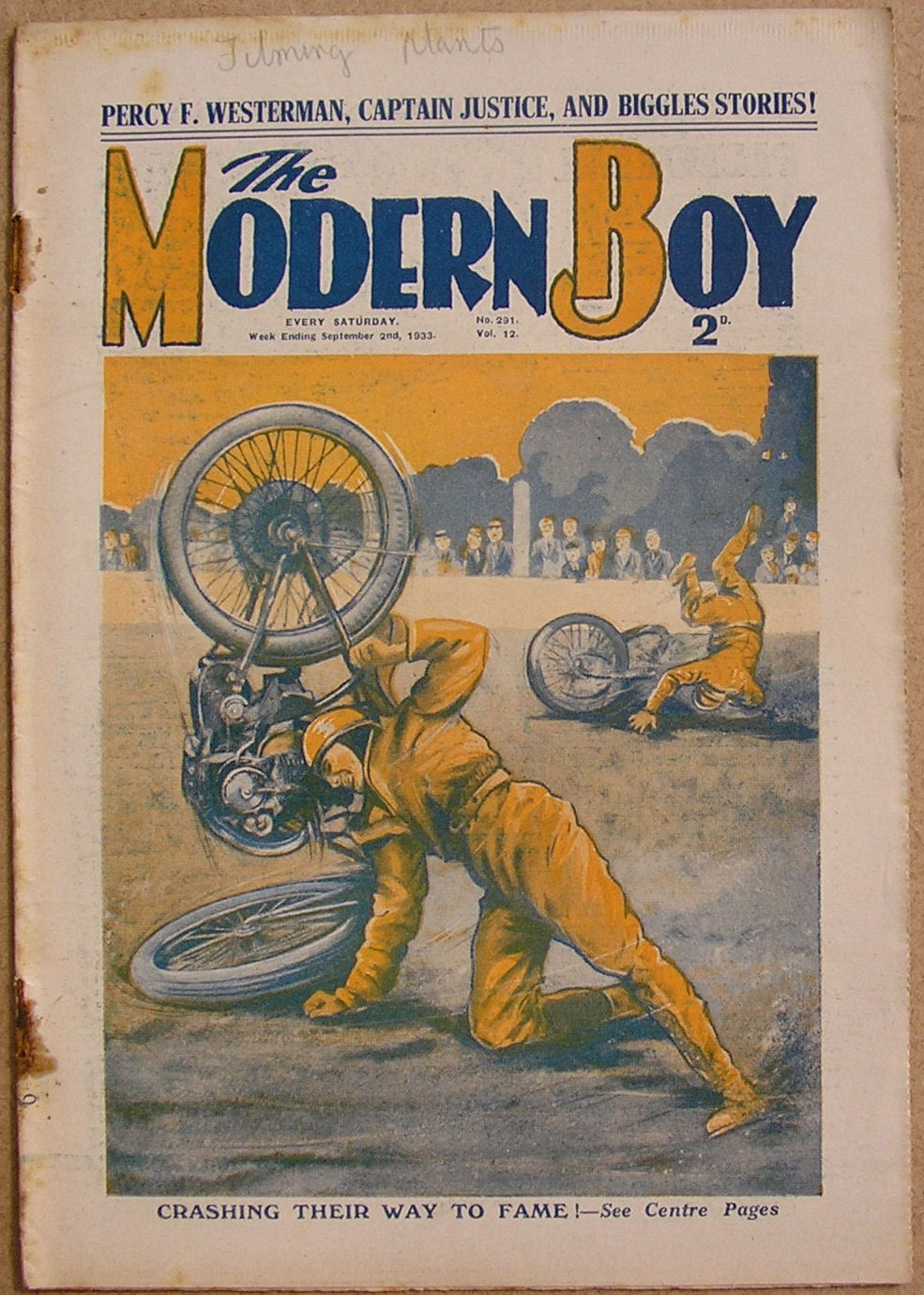
This story was later republished as "Biggles on the
Trail!" in issue number 291 of "The Modern Boy" dated 2nd
September 1933
This story was later re-written as a World War II story and
published as "Biggles on the Trail!" in the “Modern Boy’s Annual 1941”
THE GREAT ARENA (pages 157 to 174)
Click here to see story illustration
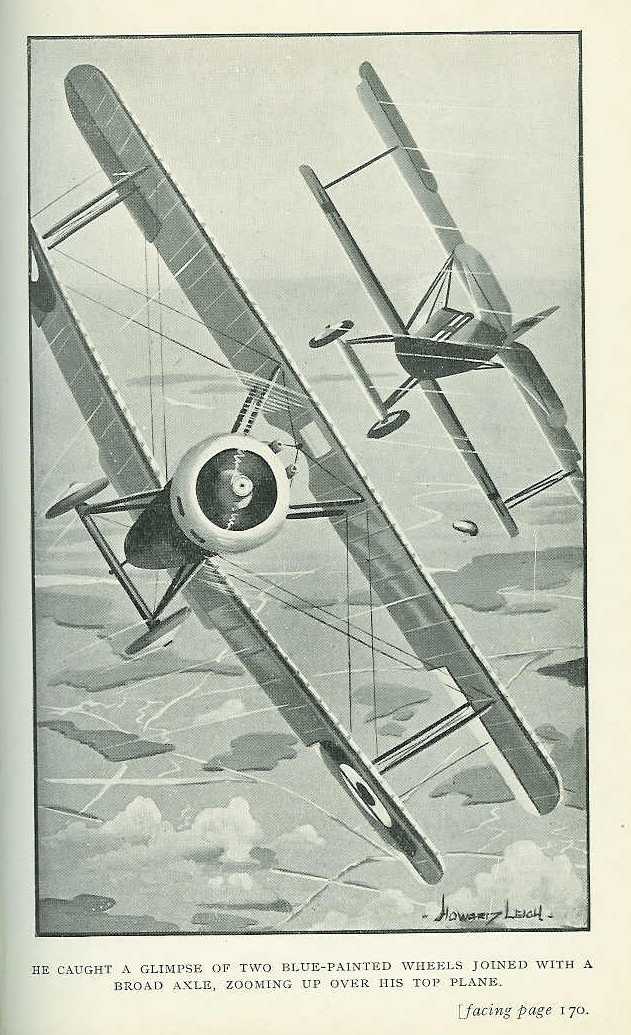
When
Biggles' guns jam against a German Ace he is allowed to live. The German
salutes and lets him fly away. Later, Biggles finds out that the German, who
flies a blue Fokker D.VII with a yellow tail, is called Von Doering and he has
been attacking new squadrons of raw recruits as they fly over from England. 266
Squadron is sent to pose as a new Squadron flying over from England in order to
set a trap for Von Doering and his 'circus' of 30 odd German aircraft. The trap
is laid and the 10 aircraft of 266 Squadron aircraft are duly attacked. However
there is a surprise literally in the wings when 24 British S.E.5's turn up to
join the fight. Biggles gives Von Doering advance warning of their arrival by
pointing at the oncoming planes, which gives Von Doering an opportunity to
escape and this lets Biggles pay back his debt to him. Henry Watkins, 'the
Professor', is shot down in the mass battle.
(We are not told in this story, or
in this book that the Professor is killed, but the character never appears
again. In the next (the fourth) Biggles
book – BIGGLES
FLIES AGAIN – in a story called “The Sheikh and the
Greek” (on page 189 of the first edition), Biggles and Algy meet a Captain
Watkins, who was Henry Watkins’ brother.
They tell him that they were with Henry when he “went west” – a
euphemism for being killed).
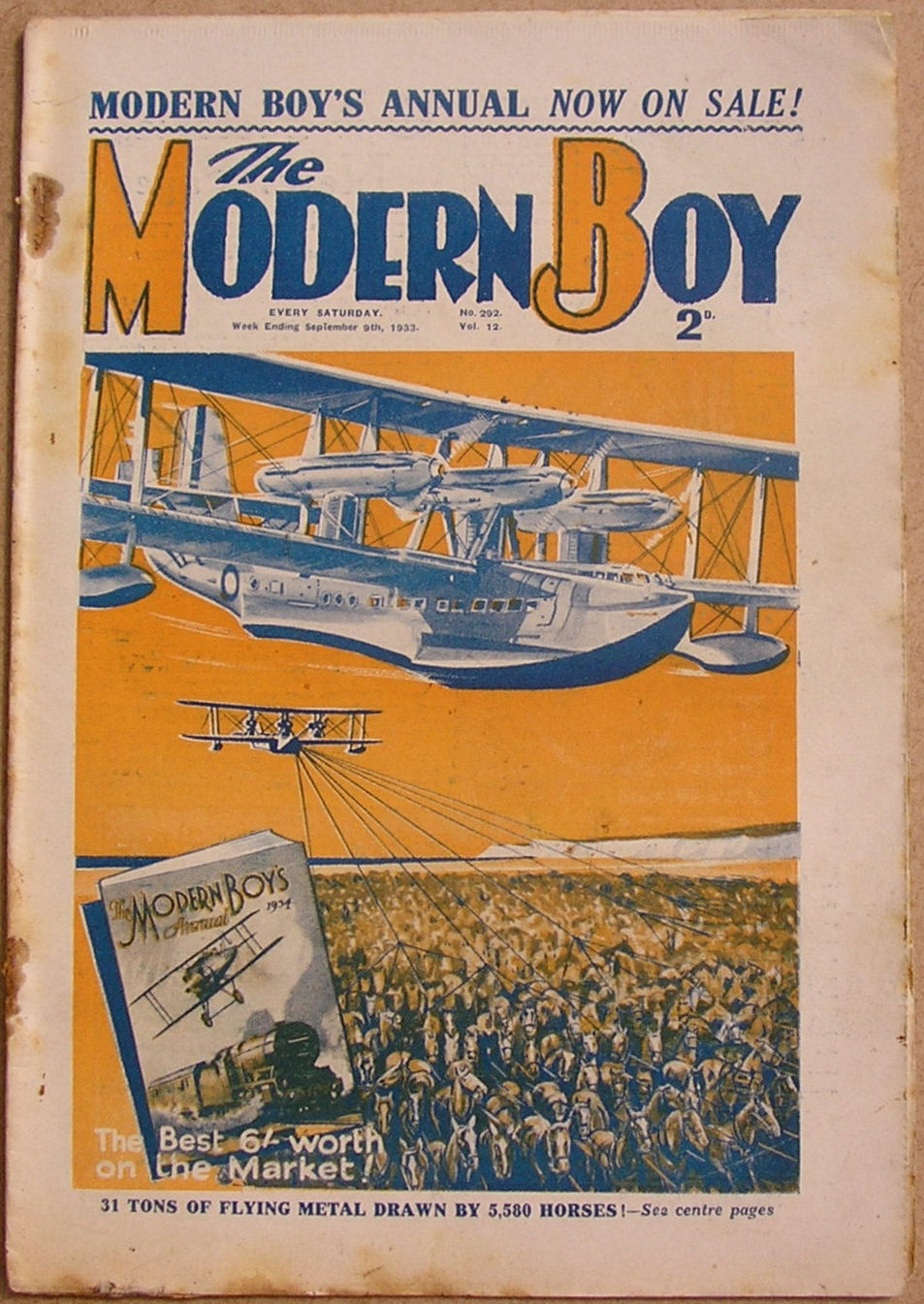
This story was later republished as "Quits!" in issue
number 292 of "The Modern Boy" dated
9th
September 1933
BIGGLES FINDS HIS FEET (pages 175 to 193)
Engine
trouble forces Biggles down in 'no-man's land' where he has a taste of trench
warfare. Jumping into a shell hole, he meets Bert Smart a wounded British
soldier whom Biggles promises to help. Returning to the British trench under
fire and under attack, Biggles helps the British soldiers at that part of the
front line repel a German attack. He sends a message to his Squadron to come
and assist and their planes are able to shoot up the German attack. This allows
Biggles to return to the shell hole in no-man's land to collect Bert and bring
him to safety. When the Thames Publishing Company republished this book in the
1950's, this story was one of two that were omitted from the reprint (the other
story being 'The Thought Reader'). This was because the stories had already
appeared in BIGGLES
PIONEER AIR FIGHTER.
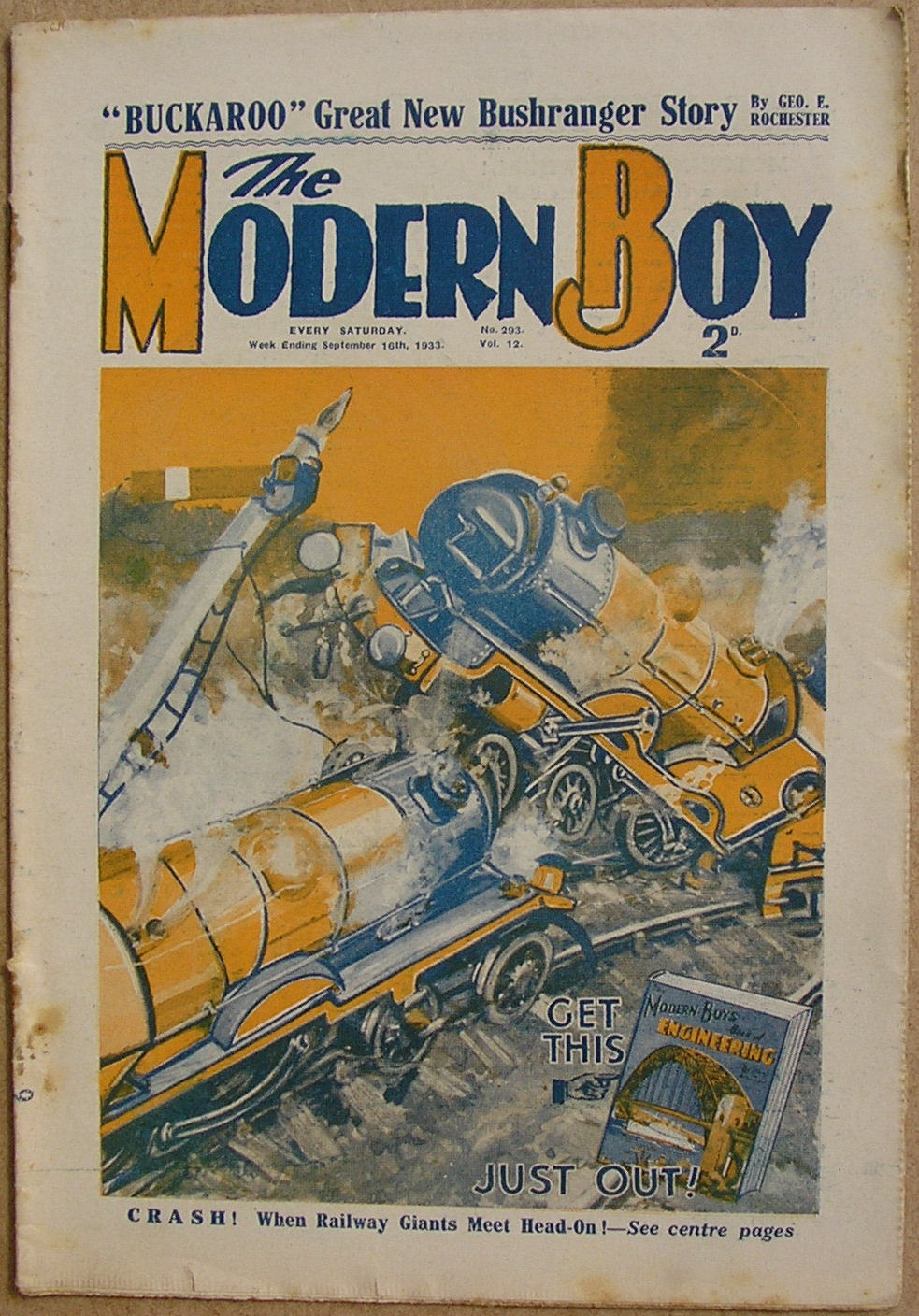
This story was later republished as "Biggles in the
Trenches!" in issue number 293 of "The Modern Boy" dated 16th
September 1933
THE DRAGON'S LAIR! (pages 194 to 212)
Click here to see story illustration
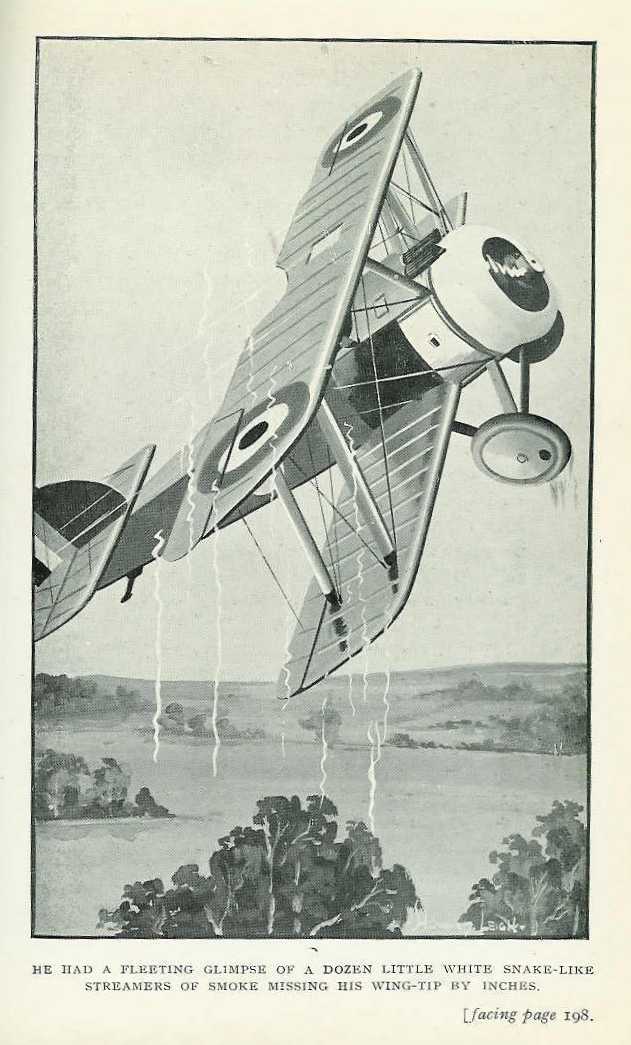
Biggles,
Algy and Henry Watkins (the Professor) are out on patrol when they see a
Bristol fighter mysteriously shot down. Biggles later discovers it was done a
huge new German anti-aircraft gun, which fires phosphorus shells. The gun is
concealed in the centre of the ruins of Chateau Contrableu, which has a
cleverly disguised removable roof. The three aforementioned pilots resolve to
get the gun. Biggles and Algy drop smoke bombs to form a smokescreen and Henry
flies over and bombs the gun with Cooper bombs. The resulting explosion is so
huge as to force Henry to land but he is unharmed and able to fly back to base
with the mission accomplished.
This story was later republished as "The Dragon’s Lair!"
in issue number 294 of "The Modern Boy" dated 23rd
September 1933
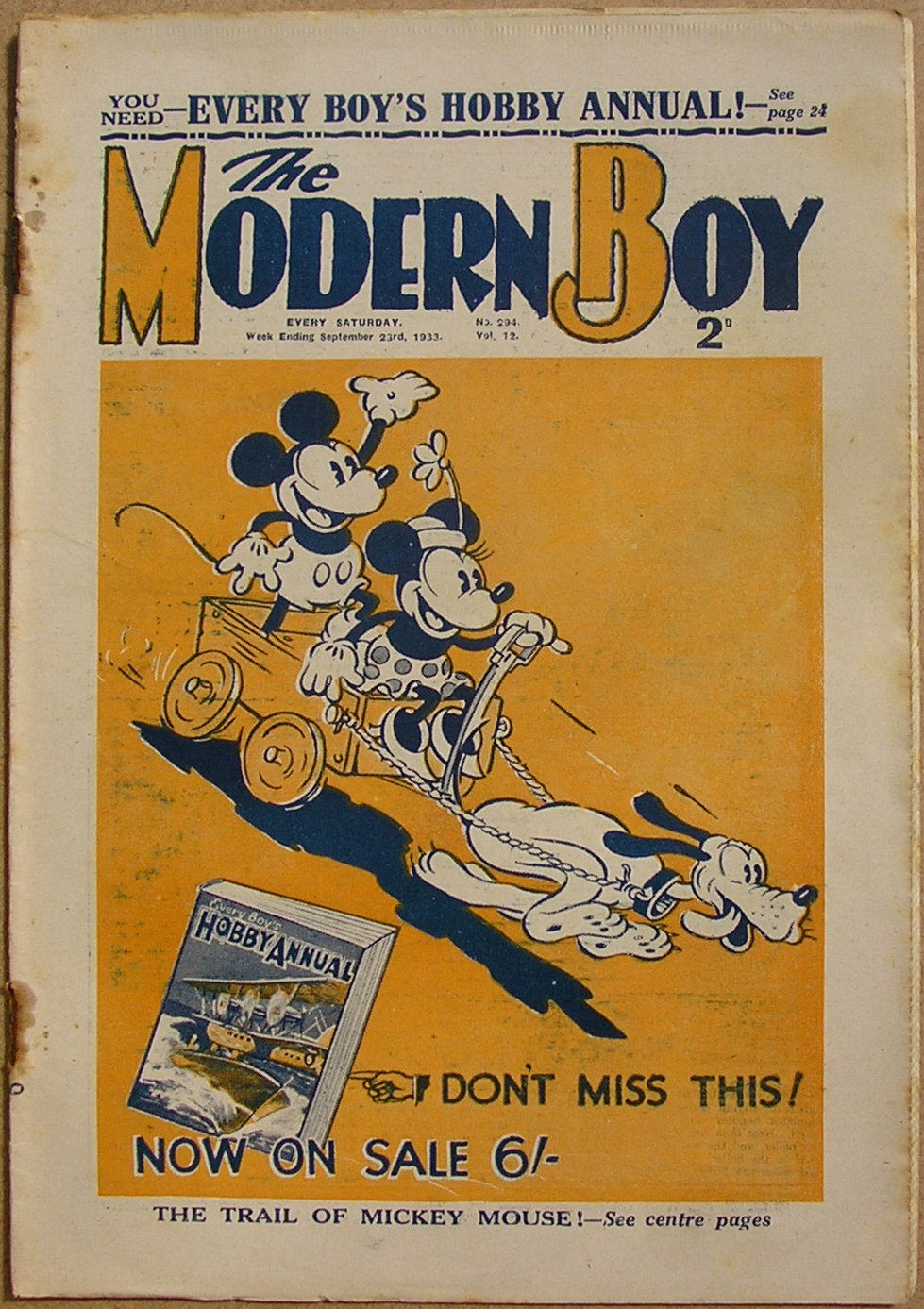
BIGGLES' DAY OFF! (pages 213 to 231)
With
no activity in his sector for a week, Biggles decides on the spur of the moment
to fly to England to visit his Godfather, Dr. Duvency. Landing his Camel in a
large garden, Biggles finds that the Doctor has invented a new type of
anti-submarine bomb and has even built a plane to try dropping it. Against his
better judgement, Biggles agrees to fly the home-made plane and test drop the
bomb. Flying out to sea, Biggles spots a real German submarine being pursued by
the Navy. He drops the bomb on it and the blast causes his machine to
disintegrate. The next thing Biggles knows, he is in the sea and being rescued
by the Navy. Biggles then has to solve the problem of how to get back to his
Squadron in time for his next patrol!
This story was later republished as "Biggles’ Day Off!" in
issue number 295 of "The Modern Boy" dated 30th
September 1933
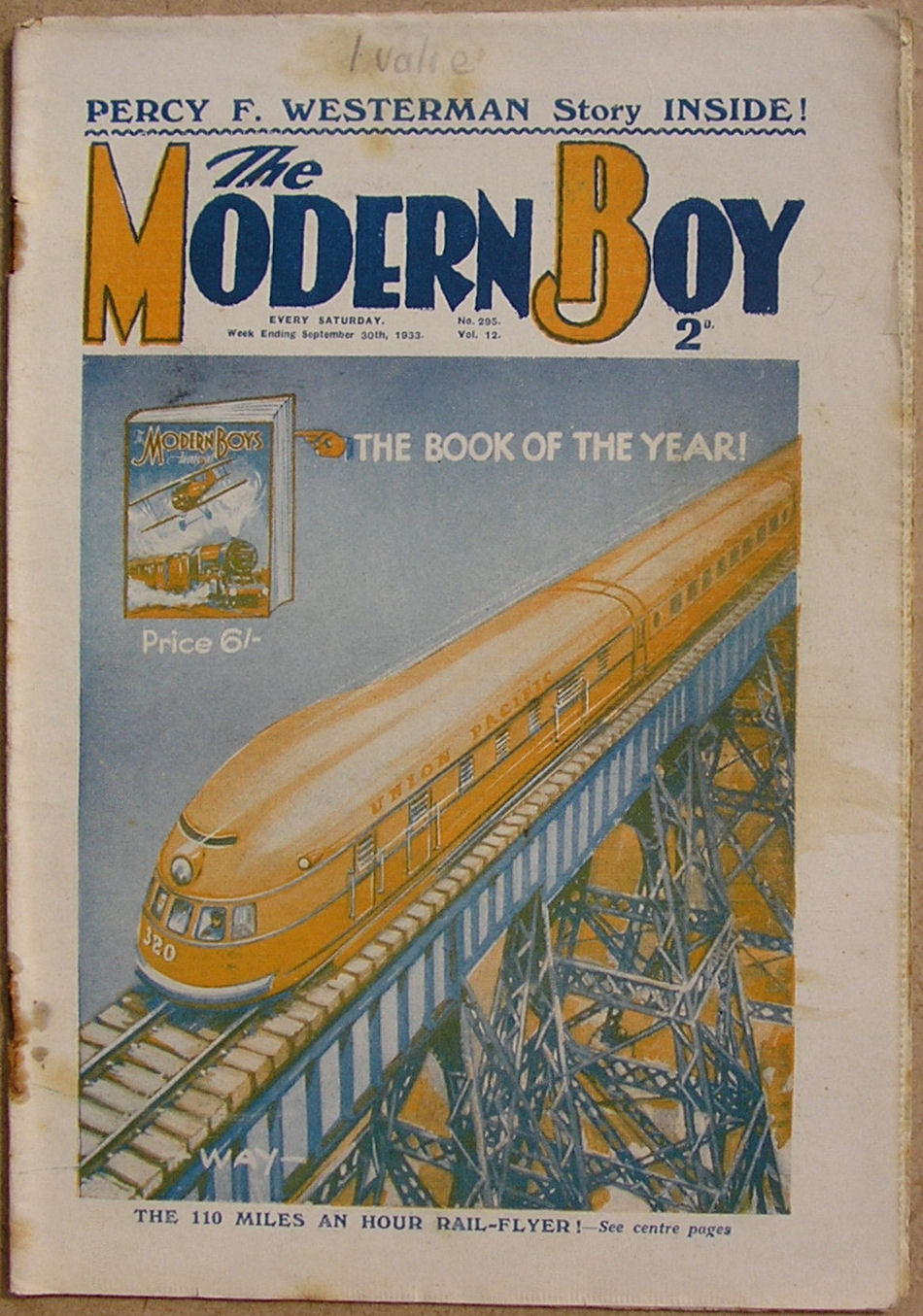
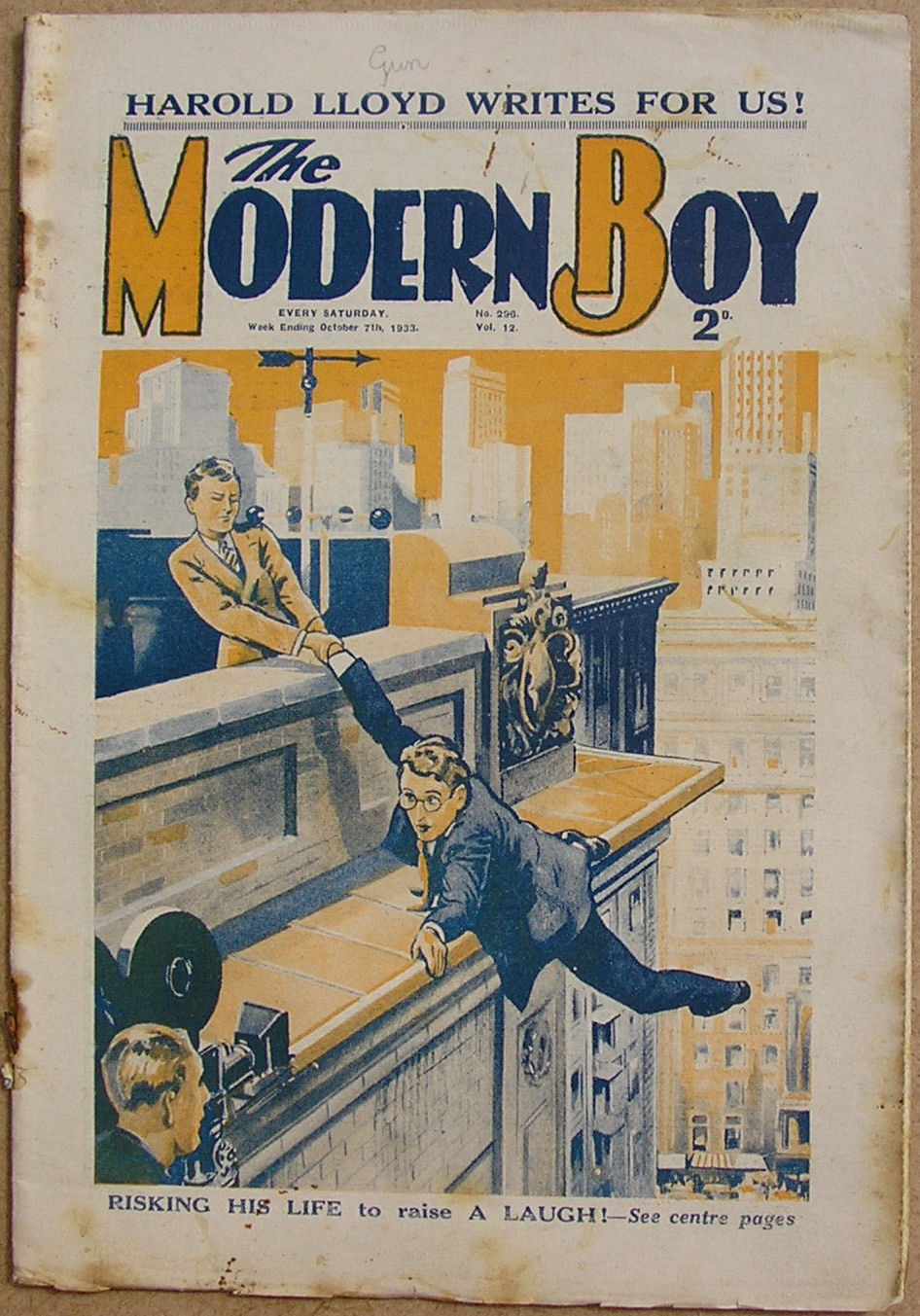
SCOTLAND FOR EVER! (pages 251 to 254)
Biggles
gets the shock of his life when he lands at the 266 Squadron aerodrome in
Maranique only to find that the Germans have broken through the British lines
and taken it over! Algy and the Professor who were flying in to land with
Biggles manage to get away. Biggles, however, is taken prisoner, but later has
a chance to escape when British planes come back to bomb the aerodrome to stop
the Germans being able to use the supplies they have taken. Biggles himself
sets fire to the ammunition store. Unable to leave the aerodrome without
discovery, Biggles decides to hide in the roofing space. The aerodrome is then
the subject of a fierce battle as the British counter-attack against the German
advance. When the Germans set up a machine gun post in Biggles' roof space, he
is able to deal with it. Scottish troops then take the aerodrome and Biggles is
cheered by the thought that he will be able to take the leave that was due to
him. "Scotland for Ever!" he tells the Scottish troops.
This story was later republished as "Scotland For Ever!"
in issue number 296 of "The Modern Boy" dated 7th
October 1933
GLOSSARY OF TERMS USED (pages 251 to 254)
(NB The Glossary is at the back of the book in the original Hamilton
edition but after the forward in subsequent reprints)
Biggles of the Camel Squadron
Publication Details - published by John Hamilton
The dust cover of the original book shows German planes under
attack.
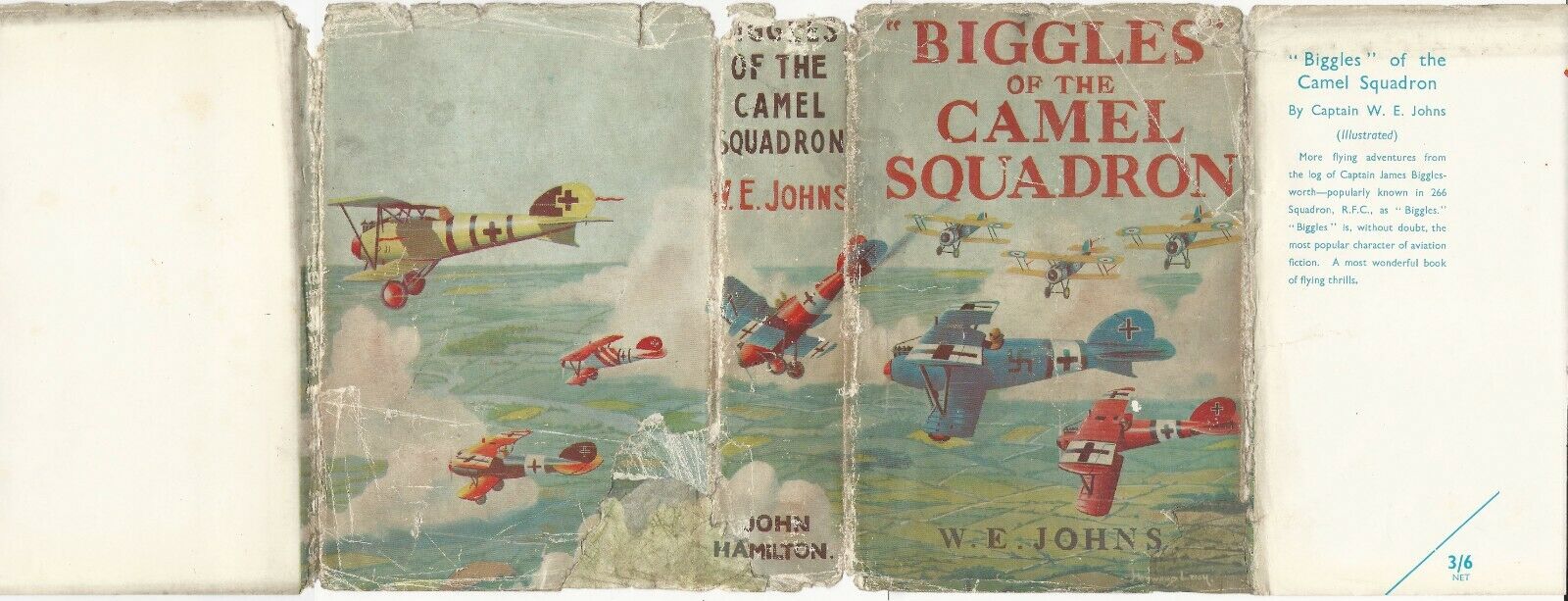
An original Dust Jacket from a later reissue
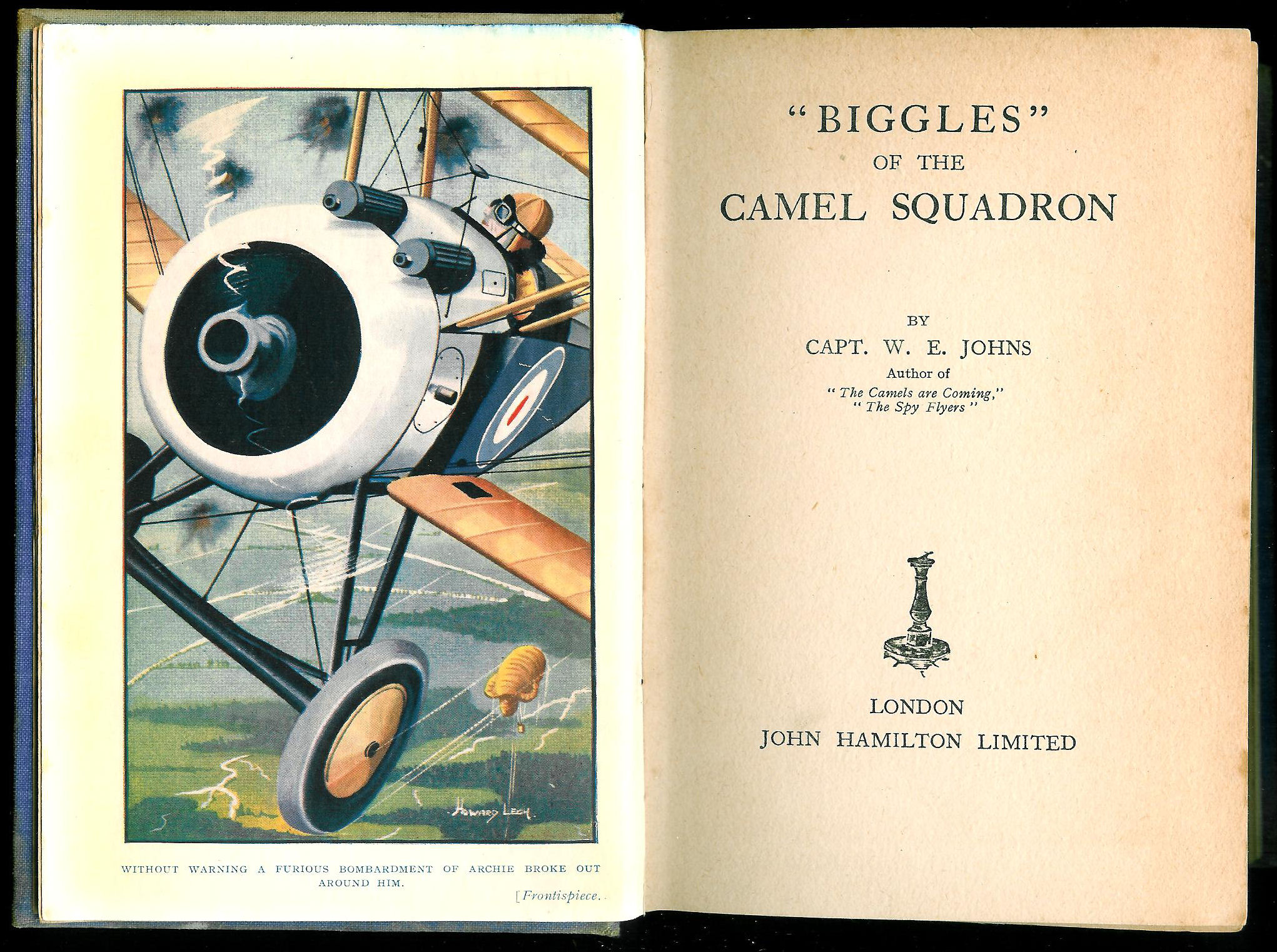
Frontispiece
(The frontispiece illustrates
a scene from page 80 of the book)
Click on the above to see it in more detail